Stop holding their documents. Hold the answer.
You check things about people for a living. An employer, a landlord, a clinic, a school, a venue, a bank, a newsroom, a family hiring help. Today that means keeping copies. SigWave gives you the answer, signed from the person's own phone, and a receipt instead, and there is no document for anyone to steal.
What changes for you
Today you hold copies. A photo of a license in a folder. A birth date in a spreadsheet. An address on a form in a drawer. Every copy is a risk you carry. It has to be stored, protected, found again and one day destroyed. If it leaks, the person is the one hurt, and you are the one who has to explain it.
With SigWave you hold two things: the answer to the question you asked, and a receipt that says who asked, who answered and when. A mark is a small wavy line that stands for one person, made on their own device. The answer is signed by that mark. Signed means it could only have come from a device on the person's own list, the phones and computers they have said are theirs. You never had the document, so there is no document for anyone to steal.
The directory at sigwave.id holds a person's mark, the list of devices allowed to speak for it, the questions and answers they chose to send, receipts of what was asked and answered with no values in them, any signed record a signer chose to publish, and notification tokens that name a device, not a person. Two more columns are being studied. One can hold a report about a mark: one reason word and the two marks, seen by nobody else. The other is a standing for each mark, worked out from blocks and those reports. Neither changes how any mark is treated, and neither shows on a mark's public page. There is no way to send a report yet. No name unless the person gives one as a label. No column for a birth date, an address or a document. The site does not track you, keeps no analytics and loads nothing from any other company. It counts asks only to hold back floods from a single mark.
How it works
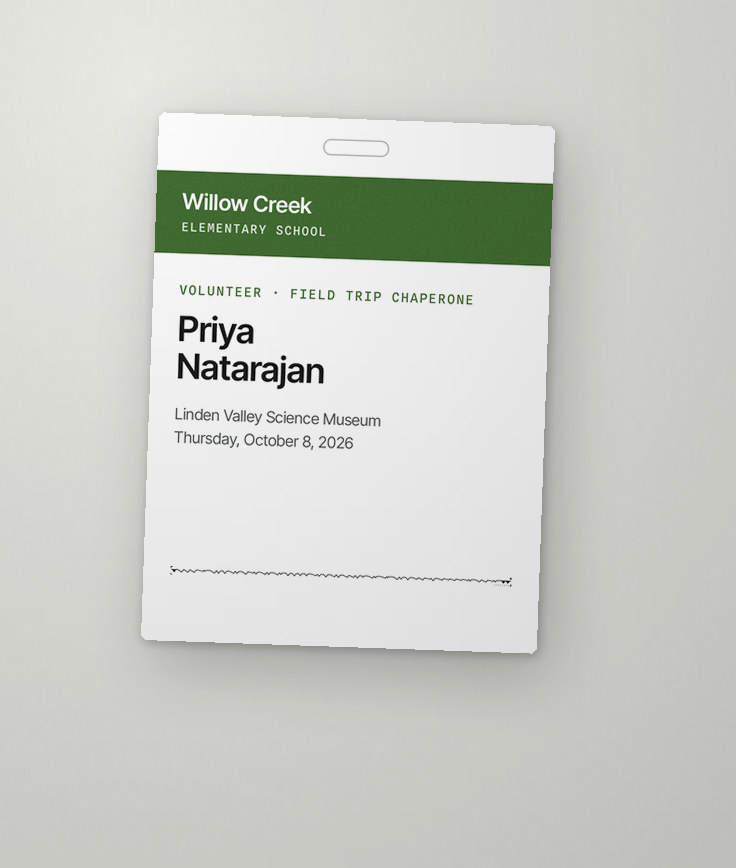
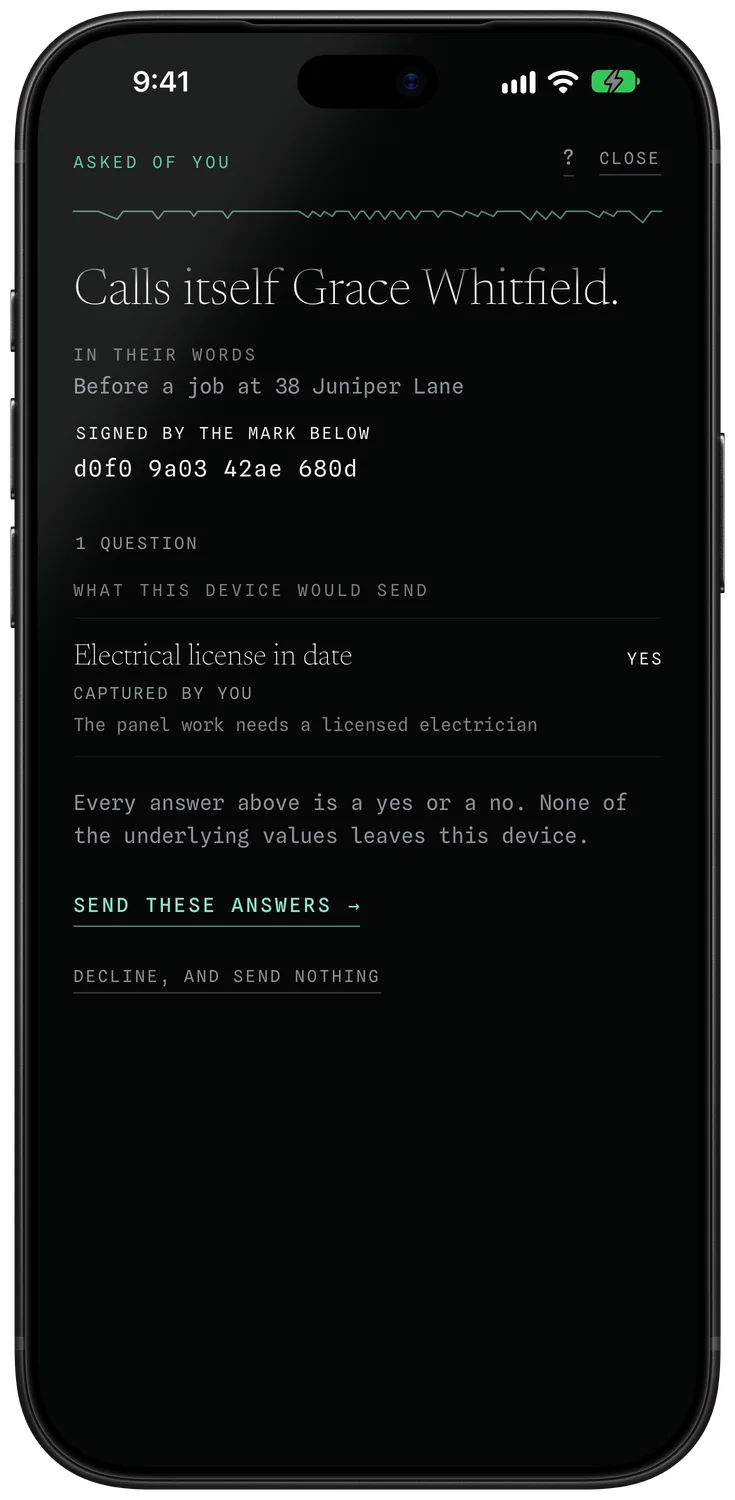
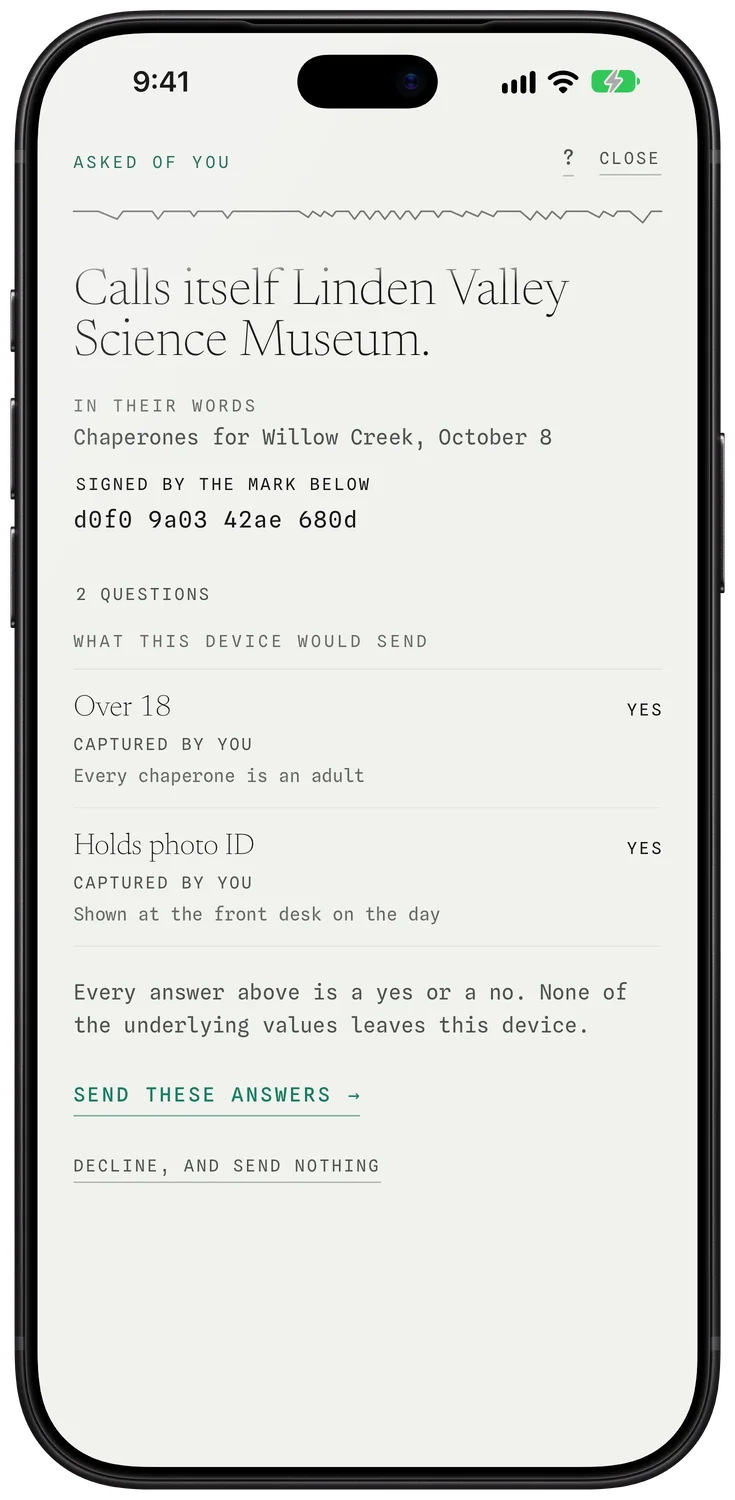
You ask. At sigwave.id/ask your own mark is made in the browser, and your ask is signed by it. You hand the person a link or a short code, or you point your phone's camera at the mark on their badge or card. They see what you call yourself, shown as "Calls itself X", and exactly what you want to know.
They answer on a device of their own. In the SigWave app, which is in testing, that means Face ID, Touch ID or their Mac's password before anything is signed. A mark made in a plain browser answers from that browser. Most questions get a yes or a no. Sometimes you need the thing itself, like their full name. That is sent only when you asked for the thing itself and they chose to send it. They can decline, and nothing is sent.
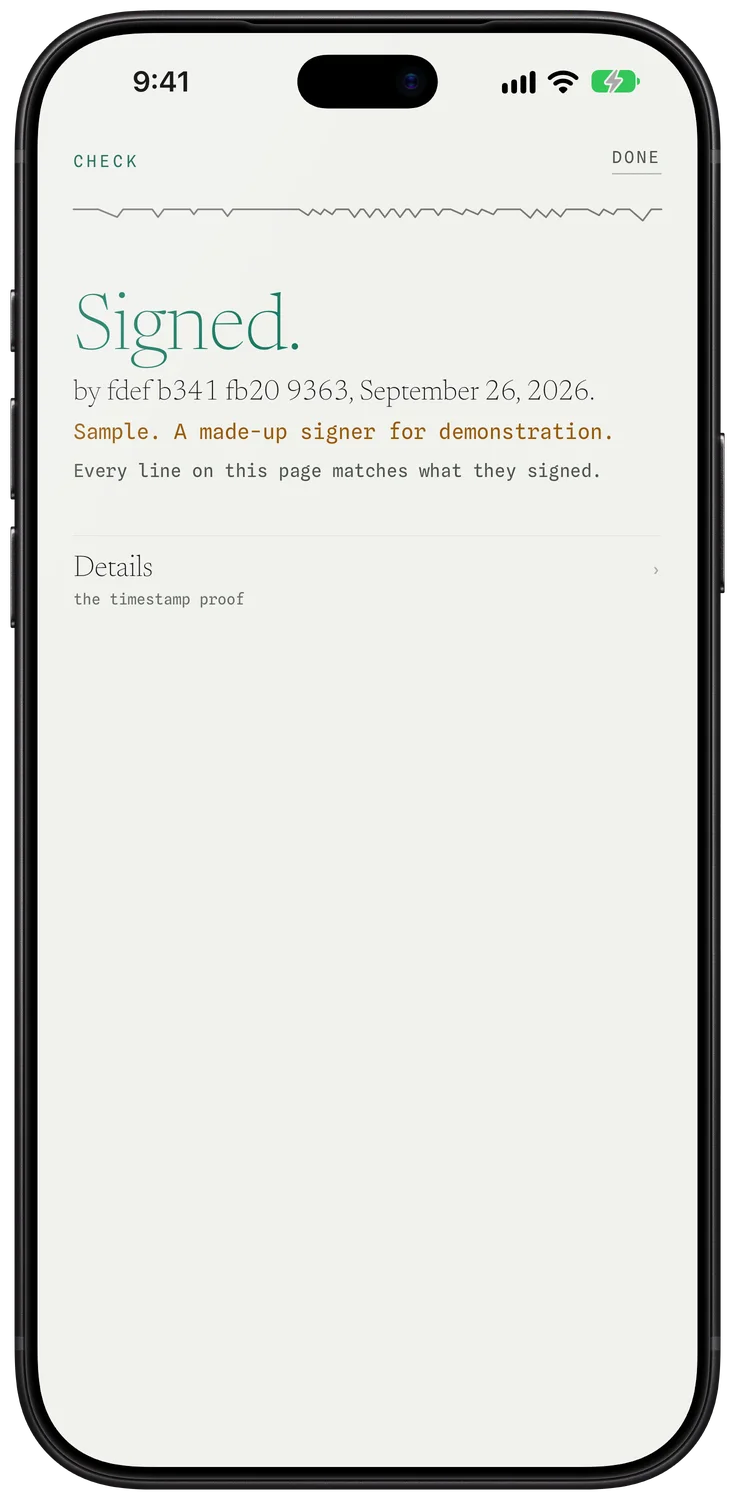
The answer arrives on the same page you asked from, and only you can read it. You also see what kind of device answered and how it holds its secret, in plain words. You both keep receipts, one for every question and every answer, each carrying its signature.
What you can ask today
These questions are ready to pick at sigwave.id/ask. Each returns a yes or a no. Today the answer is the person's own word, tied to their mark; see "If you issue credentials" below for when it becomes more. If you truly need the thing itself, like a name, ask for the thing itself, and the person sees that you did.
Official checks
Some checks need more than a person's own word. A background check needs a checking company, which we call a processor, to read real details and do real work. SigWave is building this with escrow. Escrow is a holding place. The person deposits the details for a processor you name. The processor reads them, does the work and sends back a yes or a no for each thing checked. The details go only to the authority that needs them, sealed so that sigwave.id cannot read them. You, the party asking, get an answer, never the papers. You keep the verdict and the receipts.
In development. We have built the escrow flow and tested it end to end, on test data, with a processor we run ourselves. No outside processor takes part yet, and there is no sign-up form. If you run checks for a living, talk to us.
If you issue credentials
A credential is something a person holds that you can vouch for: a license, a diploma, a job. The model is simple. A licensing board, a school or an employer is registered as an issuer and says "this person holds this". An issuer can revoke what it issued, and a later check shows it revoked.
The way for an issuer to register and issue a credential is built on our service. No real issuer has joined yet, and there is no sign-up form; talk to us. Until an issuer vouches for an answer, the answer is the person's own word, tied to their mark, and the app says so.
Building it in
An organization asks from sigwave.id/ask and reads the answer on the same page as it arrives. A written guide for building the ask into your own system is on the way; until then, talk to us and we will walk you through what exists.
A verification library (Rust today) checks a mark and its device list without calling sigwave.id. It is in use inside Synap and not yet offered outside; Swift and JavaScript versions follow.
Verified organizations
Today an organization's mark reads "Calls itself X" on a person's phone, the same as anyone's. We have a plan to prove your mark is really yours using places you are already listed: your own website, the lists regulators keep, the government's list of companies. A scam that calls itself you would then fail the check. This is in development. We are already working on it, and we have confirmed it is technically feasible under our patent-pending design.
Security
If your job is to keep your organization within the rules, start here. In the SigWave app, which is in testing, the mark's secret is made on the person's own phone or Mac, inside the part built to keep secrets, and never leaves it. The phone and the Mac ask for Face ID, Touch ID or the Mac's password before anything is signed. A mark made in a plain browser keeps its secret in that browser instead, and every answer tells you which kind of device it came from. Only a device on the person's own list can answer or sign. sigwave.id has no column for a birth date, an address or a document. It holds no name unless the person gives one as a label. A value such as a name reaches you only when you asked for the thing itself and the person chose to send it. Details set aside for an official check stay sealed for the processor. You never see them. The rest, including what is still in development and how to tell us about a problem, is on the security page.
What it costs
Making and using a mark costs a person nothing today. For an organization, talk to us.
Try it now
Make a mark at /me. Ask someone at /ask. Scan a mark or a signed page at /scan. All three work in a plain browser, take a minute and cost nothing. The SigWave app, where a person answers about themselves, is in testing.
Read the deep dive
A week in Alder Falls, a made-up town: a landlord, an electrician, a school, a clinic, a gym. What was asked, what was shared, what stayed with the person. Or see everything a mark is for, what is live today and what we are building.
Talk to us
Tell us what you check and how often. hello@sigwave.id, or the contact page.